

Modern pyrolysis systems operate under increasingly strict environmental constraints, requiring sophisticated emission control architectures to maintain compliance and operational stability. A contemporary pyrolysis unit is no longer defined solely by conversion efficiency, but by its integrated ability to manage volatile organic compounds, acid gases, particulates, and secondary condensates with precision.
Thermal degradation of polymers, rubber, and sludge-based feedstocks inherently generates complex off-gas streams. These streams exhibit fluctuating chemical profiles depending on residence time, temperature gradients, and feedstock heterogeneity. As a result, emission control must be dynamic rather than static. Short cycles of variability are common. Stability is engineered, not assumed.
In parallel, commercial demand for systems such as a plastic to oil machine for sale continues to grow, pushing manufacturers to integrate advanced abatement technologies directly into process design rather than treating them as auxiliary additions.
Multi-Stage Emission Control Architecture
A modern emission control system in a pyrolysis unit typically follows a multi-stage configuration designed to progressively reduce pollutant load. The first stage involves primary condensation, where hydrocarbon vapors are cooled rapidly to recover oil fractions and reduce organic vapor concentration in the gas phase. This step alone significantly reduces downstream treatment burden.
Secondary treatment often includes cyclonic separation and inertial demisting. These mechanisms target entrained tar aerosols and micro-particulates. The gas stream becomes progressively cleaner, yet still chemically active.
In more advanced configurations, catalytic conditioning zones are introduced. These zones promote partial oxidation of unstable hydrocarbons at controlled temperatures, minimizing formation of dioxin precursors. Such refinement is especially relevant in a tire to oil plant, where sulfur compounds and aromatic fragments are more prevalent.
Engineering design also considers scalability. A modular pyrolysis unit can be configured for batch or continuous operation, with emission systems adjusted accordingly. Flexibility is critical. No two feedstocks behave identically under thermal stress.
Thermal Oxidation, Scrubbing, and Filtration Systems
At the core of advanced emission control lies thermal oxidation. Non-condensable gases are subjected to high-temperature combustion in a controlled chamber, typically above 850°C. Residence time is strictly regulated to ensure near-complete oxidation of hydrocarbons. The process is efficient, but energy-intensive.
Heat recovery systems are frequently integrated to offset energy consumption. Waste heat from oxidation is redirected back into the pyrolysis unit, improving overall thermal efficiency. This closed-loop approach reduces auxiliary fuel dependency.
Following oxidation, wet scrubbing systems are deployed. Alkaline or neutralizing solutions absorb acid gases such as HCl and SOx. Droplet size distribution in the scrubber plays a critical role in capture efficiency. Fine atomization yields higher mass transfer rates.
Final polishing is achieved through activated carbon filtration or ceramic membrane barriers. These systems target trace organics and residual odors. The result is a significantly reduced emission profile, suitable for regulatory discharge thresholds.
Market-driven equipment such as a plastic to oil machine for sale increasingly incorporates these integrated emission layers as standard, rather than optional upgrades.

Monitoring, Compliance, and Process Intelligence
Emission control is incomplete without continuous monitoring. Modern installations deploy multi-point sensor arrays to track CO, NOx, VOC concentration, and particulate matter in real time. Data is fed into centralized control systems capable of automated adjustment.
Predictive algorithms now play a growing role. By analyzing temperature drift and gas composition, the system can preemptively adjust airflow, combustion intensity, and condensation rates. This reduces emission spikes before they occur.
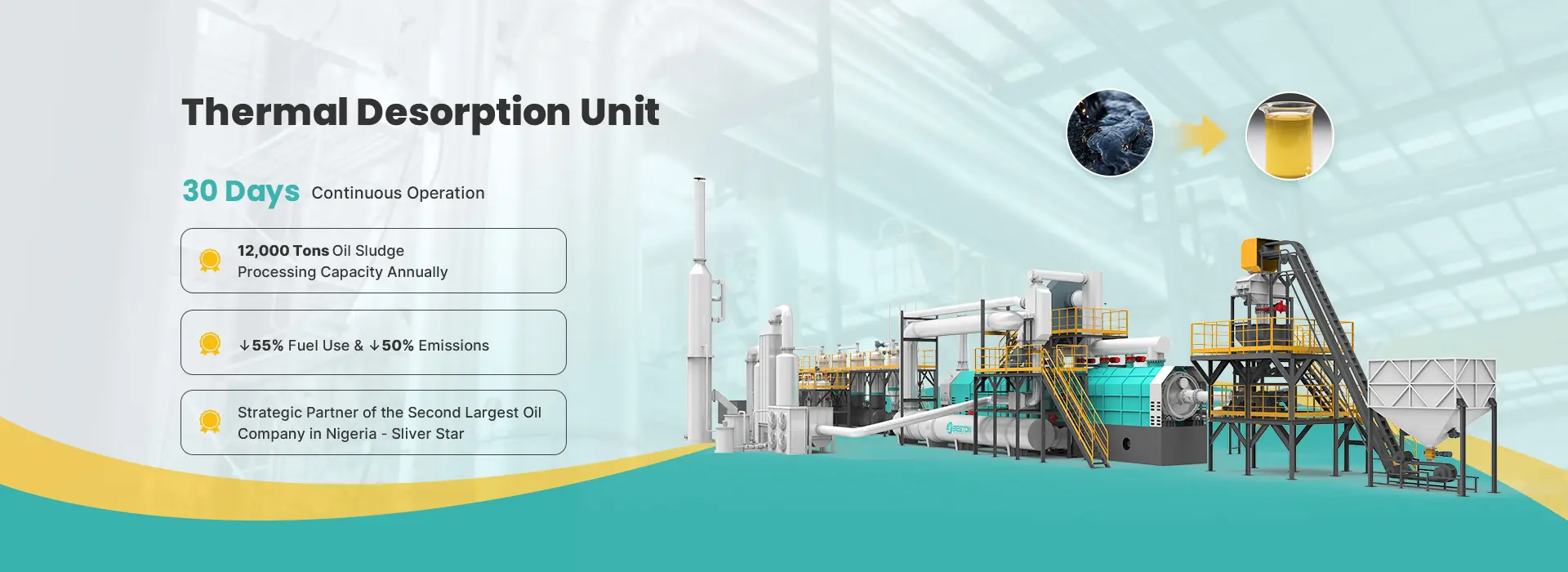
Regulatory frameworks also influence system design economics. For instance, evaluating a thermal desorption unit price often includes not only equipment cost but also long-term compliance performance and emission mitigation capability. Lifecycle emissions are increasingly considered a core valuation metric.
Similarly, procurement decisions for a tire to oil plant are now heavily influenced by its ability to maintain stable emissions under variable rubber feedstock conditions. Consistency has become as important as output yield.
Conclusion
Advanced emission control in pyrolysis operations represents a convergence of thermal engineering, chemical processing, and digital monitoring. Systems such as a pyrolysis unit are evolving into tightly regulated environmental processors rather than simple conversion machines. Integration of multi-stage oxidation, scrubbing, and intelligent control defines the modern standard. Emissions are no longer a byproduct. They are an engineered variable.
Related Posts via Categories
- Which Nut Shell Makes the Best Charcoal? Coconut, Palm Kernel, Walnut & More
- Explore Some Acceptable Raw Materials for Biochar Pyrolysis
- Top 5 Agricultural Benefits of Using Biochar
- Turning Livestock Waste into Value: A Sustainable Solution with Biochar
- Charcoal Making Machine is A Sustainable Solution for Animal Droppings Management
- 8 Reasons to Invest In A Continuous Pyrolysis Plant
- Start a Business With A Sawdust Charcoal Making Machine
- How Much Does a Biomass Pyrolysis Plant Cost?
- Get And Work With The Right Egg Box Making Machine
- How To Research The Egg Tray Machine Price – Offers One of The Best End Results Possible

